
Wesleyan in the News: October 2026
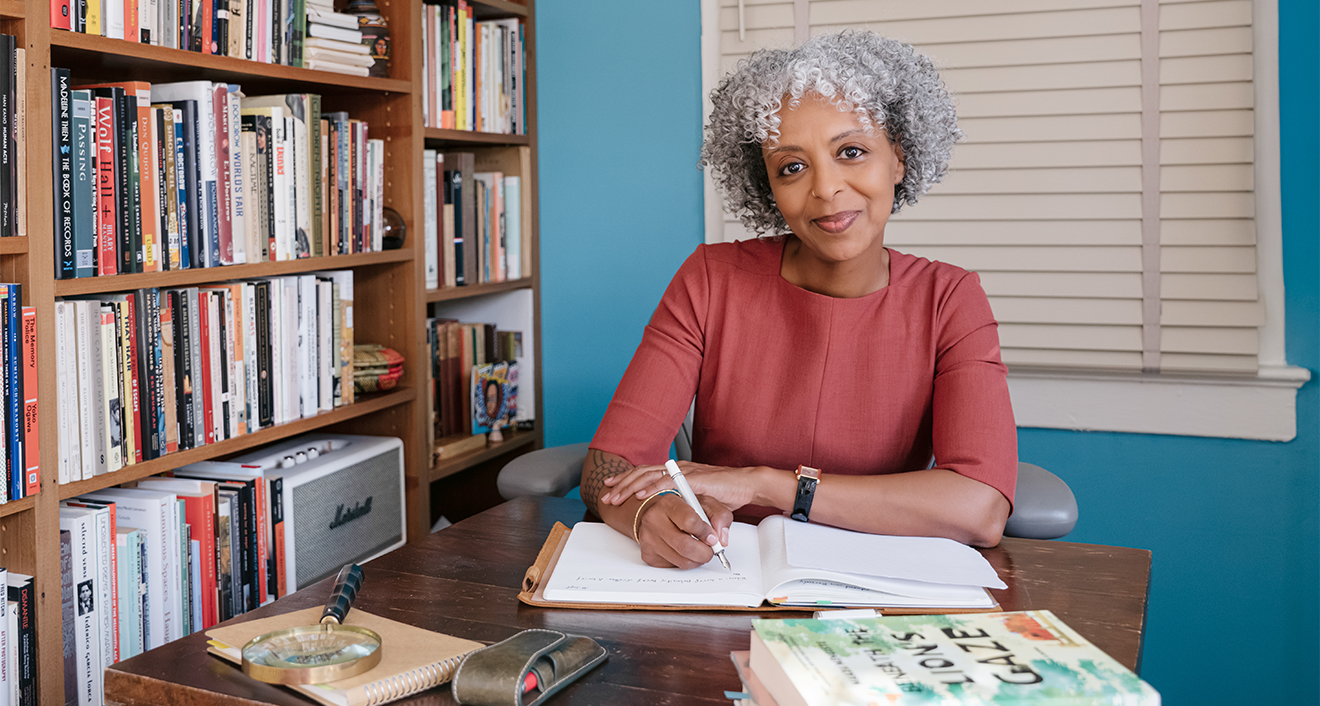
Maaza Mengiste, professor of English, was recognized in The New York Times, NPR, and CT Insider after receiving the 2026 MacArthur Fellowship Grant. Her work in fiction centers on how conflict, memory, and justice shape the historical record. Her forthcoming book, A Brief Portrait of Small Deaths, contemplates the rise of the Nazis from the perspective of Black Germans. The prestigious “genius grant” provides recipients with an $800,000 stipend distributed over five years. “Every historical record is territory rife with fault lines, with pockets of omission, and it's the task that I have dedicated my life to, finding where those spots are and at least beginning to shine a light on them,” Mengiste said in MacArthur's announcement video.
The New Yorker published A Very Safe Place, a short story by Assistant Professor of English Rachel Heng, and interviewed her about its inspiration, her character choices, and how the laws in Singapore, where the story is set, affects the piece. “I think every society makes choices about what trade-offs it is willing to make—whose liberties and whose safety are prioritized,” Heng said. “Perhaps some Singaporeans have been steeped in these choices for so long that those trade-offs have become invisible or are no longer questioned. That is as true here in the U.S. as it is in Singapore.”
A recent Wesleyan Media Project (WMP) finding that the federal government has spent at least $3.5 million on ads touting the Trump administration was mentioned on ABC News’ This Week with George Stephanopoulos.
Erika Franklin Fowler, WMP co-director and professor of government, was featured in The Washington Post in a story about the September jobs report and its potential political implications ahead of the 2026 midterm elections. Fowler explained that affordability remains “the dominant issue for most Americans this cycle,” as concerns over inflation and the cost of living continue to shape public opinion.
Fowler also appeared in Houston Public Media, discussing the importance of political advertising in competitive elections. “Advertising really matters at the margin,” she said. “It’s really in the fraction, up to a couple percentage points, that advertising can move or benefit a particular candidate.”
Michael Franz, WMP co-director and professor of government at Bowdoin College, was featured in Business Insider discussing voter concerns over data centers and how candidates are using AI in their campaigns. Franz highlighted how the pairing of these issues serves as a double whammy for challengers who are attacking AI. “Not only can you tie data centers to increasing costs, especially around energy costs, but you can also whack big elite interests at the same time,” he said.
In Al Jazeera, Franz discussed gubernatorial and congressional midterm advertising buys. As of Sept. 17, there has been at least $4 billion spent on political advertising. As Franz points out, this election cycle is on track to be “perhaps the most expensive midterm on record.”
Franz also spoke with The Washington Post about the rapid growth of AI-generated political advertising and its potential impacts on electoral campaigns. He discussed the ways in which AI advertisements utilize emotionally compelling messages, predicting that candidates across partisan lines will leverage these ads in the future. “Persuasion is often tied to the emotional punch in an ad,” he said. “You can do that in creative ways with AI.”
WMP received additional coverage in the Associated Press, The Economic Times, The Boston Globe, The Guardian, and Fox News regarding the increased presence of AI advertisements in the current election cycle. They identified at least 164 political ads generated or enhanced with AI, with 69 percent of the ads failing to disclose the use of AI tools. Travis Ridout, WMP co-director and professor of political science at Washington State University, told the Associated Press, “I think it’s a time when campaigns are really trying to figure out what are the norms surrounding this, what are the laws surrounding this?”
In an article by CNN, Ridout discussed the growing challenges posed by AI political advertisements, where voters may have a difficult time determining authentic campaign content from AI-generated material. The danger is that “people are seeing things that didn’t happen, seeing politicians say things they actually didn’t say,” he said.
Franklin Fowler, Ridout, and Franz co-wrote a piece in The Conversation on their research into AI-generated political ads this cycle. “What we found has surprised us: AI use spans from hyperrealistic deepfakes to subtle enhancements; Republican sponsors—both candidates and interest groups—are much more likely to use AI than are Democratic sponsors; and, thanks to a patchwork of state legislation, many of these ads do not disclose the use of AI at all,” they said.
Ridout was also interviewed by the Michigan Information and Research Service about the targeting of political advertisements, specifically when a voter receives ads for candidates not on their ballot. He explained how streaming and connected television (CTV) advertising facilitates more accurate targeting than traditional broadcast television. “Some campaigns use very sophisticated algorithms. Other campaigns, it might be a 19-year-old intern who’s buying the internet ad, and they don’t know how to use the dashboard very well,” he said.
The Reporter also featured the WMP’s research on AI political advertising, highlighting its expanding use in the current election cycle. The article cited the WMP’s findings that 80 percent of the political ads were sponsored by either Republican candidates or pro-Republican groups, while 11 percent were from pro-Democratic sponsors, and 9 percent were ads for independent candidates. Most ads failed to disclose the technology's use.
A book published by the Wesleyan University Press, Still House in the Desert by Brenda Hillman, was named as a finalist for the National Book Award in the poetry category. The poetry collection examines a family home in the mid-20th century through an ecological lens.
Variety interviewed Bradley Whitford ’81 about his starring role in the Broadway revival of A Few Good Men, his longstanding collaboration with Aaron Sorkin, and his upcoming Hollywood Walk of Fame honor. The three-time Emmy winner also discussed the play's contemporary relevance, the trajectory of his acting career, and his optimism toward the future of political participation and free expression. “Something I’ve been saying for a long time is—pulling together what a bunch of people have said—despair is a luxury that my children can’t afford, that their future can’t afford, and action is the antidote,” he said about political participation.
Former Foreign Affairs Analyst at the U.S. Department of State and Wesleyan alum David Abramson ’87, P’23 wrote an article in CEPA about the evolving relationship between Russia and North Korea, reinforced by their 2024 comprehensive strategic partnership treaty. He argued that the relationship is rooted in self-interest and is highly transactional; the treaty’s long-term durability will depend on Russia's military needs and China's regional influence. “The transactional nature of the partnership suggests that the relationship might be of little value to Russia beyond the war.”